Have you ever seen your business grow rapidly, only to face unexpected roadblocks? For growth-stage entrepreneurs, this phase brings both opportunity and strain. Revenue climbs, but so do complex issues that trip up many firms. This article explores the stages of business growth and the common challenges of growth in business. We provide you with practical solutions, reliable business frameworks, and models, as well as examples that will help you achieve success in scaling a business. With the right approach, you can effectively address these issues to achieve lasting success.
Understanding the Growth Phase of a Business
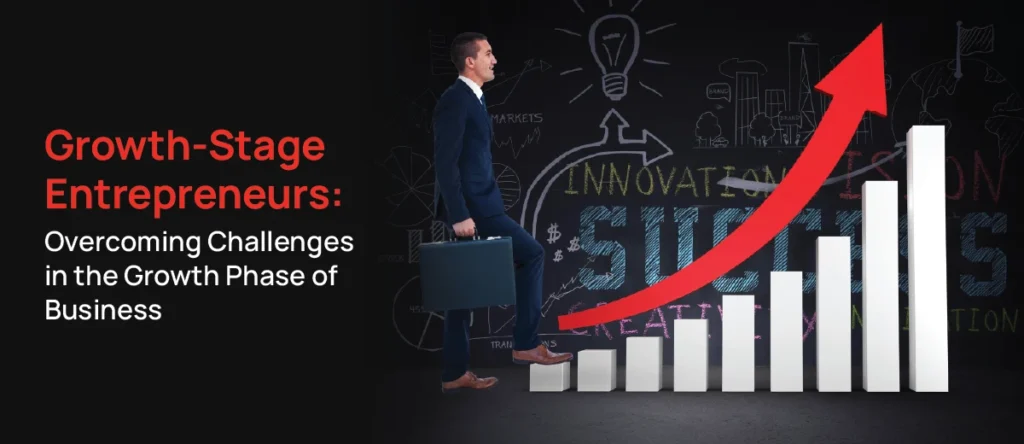
The growth phase begins when a business has proven that its idea works. During this stage, the focus of growth-oriented entrepreneurship is on increasing revenues, expanding market share, and building a strong team.
Key metrics to watch include:
- Revenue growth in the range of two to three times annually
- Market share approaching or exceeding 10%
- Team growth from 10 to 100 employees
Early-stage businesses focus on survival and acquiring their first customers. But growth-stage companies deal with more rules and bigger operations. Common challenges of running a small business turn into bigger ones during the growth phase, like operational complexity, resource constraints, scaling technology, market expansion, and leadership demands. For example, your business may now need to implement systems capable of handling ten times more orders. Your leadership team must also evolve and manage bigger teams. In the upcoming sections, we explore these challenges in greater detail.
What are the Challenges Faced by Growth-Stage Entrepreneurs?
When a business is growing rapidly, every part of the organisation feels the impact. The main challenge for growth-stage entrepreneurs is scaling the business efficiently without losing control.
1. Founders Struggle to Let Go
Early success is often built on the founder’s direct involvement in every decision. As the team grows, that hands-on control fades. Delegating without losing quality, speed, or vision is something most founders are simply not prepared for.
2. Pricing Fails to Reflect True Value
The price you charge to win your first clients is not necessarily the amount you’re truly worth as a business. Repricing existing clients is uncomfortable, as is charging new clients different rates. Many businesses leave significant revenue on the table by avoiding this conversation for too long.
3. Revenue Depends on Too Few Clients
Many growth-stage businesses discover too late that a handful of clients account for the bulk of their revenue. Losing even one can destabilise the entire operation. Diversifying your client base while managing existing relationships requires deliberate effort and early action.
4. Decision-Making Becomes a Bottleneck
More stakeholders mean more opinions, meetings, and delays. Decisions that once took hours now take weeks, and in a fast-moving market, that cost is significant. Bureaucracy at this stage is one of the most underrated reasons promising businesses stall.
5. Sales and Marketing Pull in Different Directions
Sales teams scale quickly due to immediate revenue pressure, while marketing does not receive the same urgency. The result is a weak pipeline, inconsistent messaging, and a brand that cannot support the growth the business is actively pursuing.
6. Brand Identity Gets Lost at Scale
When the team is small, everyone understands the voice, values, and standards. As the organisation grows, inconsistency creeps in. A fragmented brand confuses customers and quietly erodes the trust built over time.
7. Culture Breaks Down Under Rapid Growth
Culture does not sustain itself. In the early days, it develops naturally. At scale, it requires intention. Left unmanaged, it leads to silos, disengagement, and a team that no longer shares the same direction. By the time it becomes visible, it is already expensive to fix.
Build momentum, overcome challenges, and scale your business confidently
What are the Solutions and Frameworks to Grow Successfully?
Beating the challenges of growth in business requires clear plans and adherence to proven business frameworks and models. Here are key ways to succeed in the growth phase of business.
1. Modular Product Architecture
Build scalable systems that blend with demand. This keeps things agile as you scale a business. Start with microservices so teams can update parts independently. Also, use APIs to connect systems smoothly. Moreover, containerisation technologies, like Docker, make deployment reliable.
2. Bring in the Right Expertise
Hiring a consultant or advisor at the right stage can save you from costly mistakes. An experienced outside perspective helps you identify gaps, prioritise decisions, and build a growth strategy that is grounded in real market experience.
3. Diversify Your Revenue Streams
Relying on a single product or client is one of the biggest risks during the growth phase. Expanding into adjacent offerings, new markets, or complementary services builds resilience and keeps revenue flowing even when one stream slows.
4. Invest in the Right Technology
Technology should solve real problems, not add complexity. The right tools streamline operations, reduce manual work, and provide clear visibility into performance. Start with what your business genuinely needs today and build from there.
5. Build a Strong Company Culture
Culture shapes how your team performs under pressure. Clear values, open communication, and a genuine investment in people create an environment where talent stays, accountability grows, and the business scales without losing its foundation.
6. Keep the Customer at the Centre
Growth built on strong customer relationships lasts longer than growth built on acquisition alone. Listen actively, improve based on feedback, and make every touchpoint feel intentional. Satisfied customers are your most cost-effective growth engine.
7. Adopt Business Frameworks Like Lean Scaling
Business concepts like lean scaling focus on achieving growth with minimal waste. Two-speed roadmaps differentiate small, day-to-day fixes from large, long-term transformations. While financial planning involves estimating cash flow for the next year, scenario planning prepares for market changes.
8. Pivot-Ready Mindset
Keep everyone informed with updates at every level. Build with agile structures that enable you to pivot quickly. Start with a test market on a small scale. These steps help growth-stage entrepreneurs turn problems into wins. Also, regular check-ins keep everyone aligned and moving forward together.
Frameworks & Models to Scale a Business
OKRs align teams around common goals, while Lean Scaling removes the fluff to accelerate growth. Two-speed roadmaps connect daily tasks to the large vision, and diversified revenue reduces dependency on a single income source. Operational efficiency means using automation tools to do more with less.
Market expansion frameworks guide safe geographic or product-line growth. Financial planning models track cash flow, fundraising, and investor reports. Innovation frameworks allow for the adoption of AI/ML without disruption by testing new technologies in smaller controlled stages first. Together, these tools simplify and structure the different stages of business development.
Real-Life Examples of Growth-Stage Success
Netflix faced challenges of business growth, pivoting from DVD rentals to streaming. They succeeded in achieving significant gains through algorithmic personalisation. Now they are one of the biggest streaming platforms in the world. DoorDash, on the other hand, solved scale challenges through artificial intelligence-powered route optimisation and demand forecasting, which helped them improve order flow. A leading mobile ad platform grew 18 times by scaling its database and analytics, tackling technical debt early on. These firms used business frameworks and models like OKRs and agile teams and they stayed pivot-ready. Their success proves smart plans win in the growth phase of business.
Join ASCENT Foundation to scale smarter with India’s top entrepreneurs
Conclusion
The growth phase of a business tests entrepreneurs, but solutions do exist. Address these common challenges faced by growth-stage businesses with strong teams, the right technology, and proven business frameworks and models. Stay flexible, plan your finances strategically, and align your operations. This is how you scale a business to new heights. Join our trusted entrepreneurial community in India for support and guidance and explore ASCENT Foundation membership today.
FAQ’s

ASCENT Foundation
ASCENT Foundation is a non-profit community for growth-stage entrepreneurs, focused on mentoring and peer learning. Founded in 2012 by Harsh Mariwala, ASCENT brings entrepreneurs together to share knowledge, build meaningful connections, and support each other’s growth.