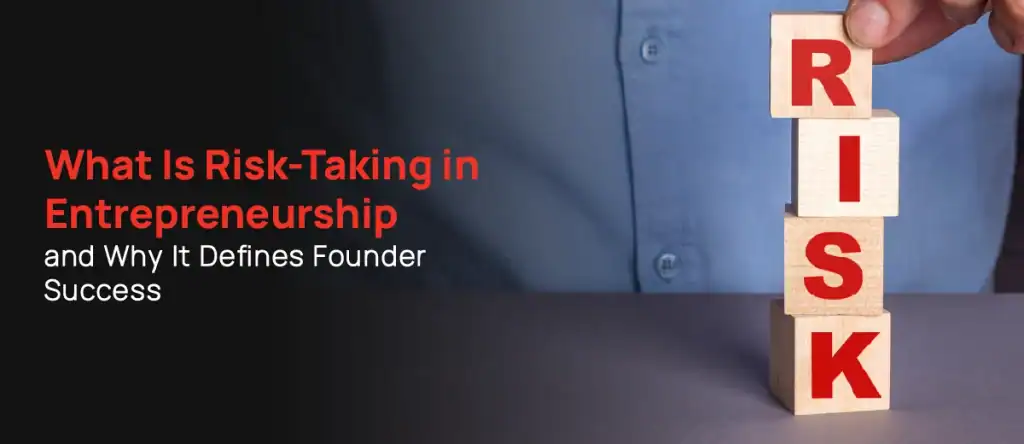
Every founder, at some point, has stood at a crossroads where the safe path and the right path were not the same thing. The choice made in that moment and the quality of the thinking behind it often determine how far the business goes. Risk-taking in entrepreneurship does not mean fearlessness or recklessness. It means being intentional in decision-making amidst uncertainty, using all the best available information. This blog looks into what that actually means, the psychology behind it, and what sets apart founders who can handle risk strategically from those who struggle with it.
What Is Risk-Taking in Entrepreneurship: Beyond the Common Misconception
When most people think about risk-taking in entrepreneurship, they picture someone betting everything on a hunch. The reality is far more considered than that. Entrepreneurs are risk-takers by design, but not by impulse. The distinction between reckless risk and calculated risk is where most of the misunderstanding lives.
Reckless risk is driven by urgency, ego, or the fear of missing out. Calculated risk is driven by information, experience, and a clear-eyed understanding of what could go wrong and what it would cost. The best founders are not the ones who take the most risks. They are the ones who take the right risks at the right time.
Risk tolerance in entrepreneurship is not a fixed personality trait. It is shaped by mindset, accumulated experience, and the environment a founder operates in. Someone who has navigated setbacks before develops a different relationship with uncertainty than someone facing their first significant decision. That is why the environment around a founder matters as much as the founder’s own instincts.
The Psychology That Drives Risk-Taking Behaviour of Entrepreneurs
The risk-taking behaviour of entrepreneurs is rooted in a specific set of psychological traits that create a foundation for acting well under uncertainty.
1. Growth Mindset: Viewing Uncertainty as a Learning Opportunity
The true meaning of a growth mindset for entrepreneurs is to view any uncertainties in the business as opportunities instead of threats. Those who develop this strength become much more ready to embrace risks constructively. Instead of being afraid of possible failure, they think about how they can benefit from it.
2. Purpose-Driven Motivation: Mission Reduces Fear
When a founder is deeply connected to why they are building something, the fear associated with risk becomes smaller relative to the mission. The stakes feel high, but the reason for taking them feels higher.
3. High Tolerance for Ambiguity: Acting Without Complete Information
Most significant business decisions have to be made without complete information. Founders who can make clear decisions despite uncertainty do not ignore what they do not know; they make the best judgement based on the information available to them.
4. Emotional Resilience: Staying Clear-Headed Under Pressure
The ability to be clear-headed in the midst of all the chaos, handle a setback while not losing focus, and still be able to make sound decisions even when the situation is the most critical is what differentiates the founders who will grow long-term from those who will retreat.
Make Better Business Decisions With Trusted Peer Insights
Why Entrepreneurs Take Risks: The Deeper Motivations
Understanding why entrepreneurs take risks means looking beyond the surface-level answer of profit or ambition. The motivations run deeper than that.
Intrinsic motivators are often the most powerful. Curiosity about what is possible, the desire to build something that did not exist before, and a need for autonomy in one’s own direction all push founders willingly toward uncertainty. These are not motivations that can be manufactured. They are either present or they are not, and when they are, they make the discomfort of risk far more tolerable.
Extrinsic motivators also play a role. A significant market opportunity, competitive pressure, or the desire to build a lasting legacy can all create the conditions under which a founder decides that not taking a risk is actually the greater risk. Standing still in a moving market is its own form of exposure.
The importance of risk-taking in entrepreneurship extends beyond individual business outcomes. Risk is the mechanism through which innovation happens. Without founders willing to challenge the existing way of doing things, industries do not evolve. Risk, in this sense, is not just the price of ownership; it is the price of progress.
Calculated Risk: How High-Performing Entrepreneurs Evaluate Before They Act
The difference between a good risk and a poor one is rarely visible in the outcome. It is visible in the process that preceded it. High-performing founders approach entrepreneurs and risk-taking with a discipline that leaves very little to chance.
1. Gathering Information and Stress-Testing Assumptions
Before committing to a significant decision, founders gather information and challenge their own assumptions. They ask what they know, what they are assuming, and what they do not yet know. They run scenarios: what does success look like, what does failure look like, and what is the cost of being wrong?
2. Starting Small and Piloting Before Committing
Testing a hypothesis at a contained scale before scaling reduces the cost of being wrong and sharpens the thinking before going all-in on execution.
3. How Experience Sharpens Risk Judgement Over Time
Pattern recognition improves with every decision a founder has made and every outcome they have observed. What feels like intuition in an experienced founder is often accumulated judgement built over years of navigating similar territory.
4. The Role of Peer Perspectives in Refining Risk Decisions
High-performing founders do not evaluate risk alone. They seek out perspective from peers who have faced comparable decisions, mentors who can offer an external perspective, and communities where honest challenge is the norm rather than the exception. The quality of a risk decision improves significantly when it has been tested against the thinking of people who have no agenda other than helping the founder think more clearly.
The Role of Support Systems in Risk-Taking
No founder takes a risk in a vacuum, even when it feels that way. The quality of the support system around a founder has a direct bearing on the clarity of their decisions.
1. Mentors: Perspective From Experience
Mentors bring perspective from having navigated similar decisions. Their value is not in telling a founder what to do. It is in helping them see what they might be missing, what assumptions might be wrong, and what the decision looks like from a distance rather than from the inside.
2. Peers: Honest Challenge Without Hierarchy
A founder who is navigating a similar stage of growth, in a different industry, carries no conflict of interest and no hierarchy. They can engage with a problem honestly and challenge thinking in ways that a mentor or an internal team member often cannot.
3. Peer Groups: A Structured Environment for Stress-Testing Bold Moves
The right peer group creates a structured environment for stress-testing bold moves before they are made. Attending an entrepreneur meet or engaging with peer exchange platforms that are genuinely built around peer learning rather than surface-level interaction can shift the quality of a founder’s risk decision significantly.
4. Building the Right Room Around You
When the people around you have the experience, the honesty, and the trust to engage with your hardest decisions, risk-taking stops being a solitary act and starts being a collective intelligence exercise. This is where the environment a founder builds around themselves becomes a genuine strategic asset.
How ASCENT Foundation Supports Founders in Navigating Risk
Most founders do not lack the courage to take risks; what they often lack is the right environment to think them through properly before committing. ASCENT Foundation brings together growth-stage founders in a trusted peer-learning ecosystem built around honest, experience-led exchange.
- Trust Groups create a confidential space where founders bring their most difficult decisions to a circle of non-competing peers who have navigated similar crossroads.
- PowerUp Sessions offer one-on-one access to accomplished industry leaders and domain experts who bring an objective external perspective to the decisions that matter most.
- ASCENT Huddles bring 50 to 100 founders from different industries together alongside subject experts for structured knowledge transfer that surfaces angles no single sector could generate alone.
- Special Interest Groups connect founders through focused, theme-led communities across finance, marketing, AI, HR, leadership, and more.
- Boardroom Sessions give ASCENT members exclusive access to present real business challenges to accomplished business leaders and industry pioneers.
- The ASCENT Conclave is the foundation’s flagship annual gathering, bringing the entire community together in one room.
Within this ecosystem, the risk-taking behaviour of entrepreneurs evolves from individual instinct to collective intelligence. Explore ASCENT membership or connect through entrepreneur events in India to find out how the ecosystem supports founders at every stage of the growth journey.
Take the Next Step in Your Entrepreneurial Journey
Conclusion
Risk-taking is not what separates successful founders from unsuccessful ones. The quality of risk-taking is. The founders who build something lasting are the ones who have developed the mindset, the judgement, and the support systems to take the right risks at the right time. Building that judgement is a lifelong process, and the environment you build around yourself is one of the most important investments you can make towards it.
Faqs