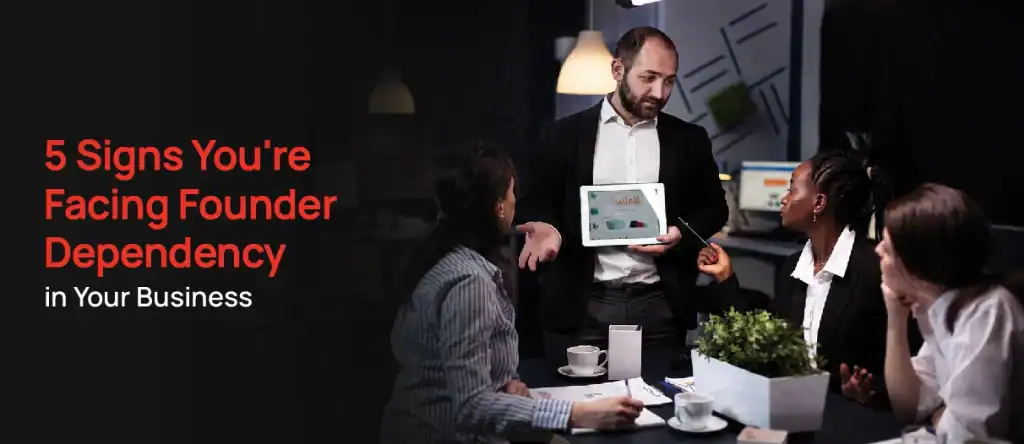
Building a founder-led business from the ground up requires deep involvement from the founder. In the early stages, that involvement is what keeps the business alive. The problem is what works at the start can quietly become what holds a business back. Founder dependency is one of the most common and least discussed growth challenges that these businesses face. It develops gradually, often without the owner realising it, and by the time it becomes visible, it has usually been limiting growth for longer than anyone wants to admit. This blog explores the warning signs and what to do about them.
What Is Founder Dependency and Why Does It Hold Businesses Back?
Founder dependency occurs when a business becomes so reliant on one person that it cannot function, grow, or make meaningful decisions without them. It is the difference between leading a business and being required by it. A leader who sets direction, builds capability, and creates the conditions for the organisation to move independently. A founder who is required becomes the single point of failure for every significant decision, relationship, and outcome.
The founder bottleneck is where this shows up most visibly. As decisions queue up waiting for approval, teams lose momentum because they cannot move without sign-off. And the founders themselves, despite working harder than ever, find that growth has plateaued.
5 Signs Your Business Has Become Too Founder-Dependent and Why They Matter
1. Every Important Decision Waits for Your Approval
When every project stalls waiting for founder approval, centralised decision-making has officially begun to limit the business’s speed and capability. Often, founders have unintentionally trained their teams to seek approval by overriding decisions or being the first person everyone turns to when something feels uncertain. Over time, the team stops trusting their own judgement because it has learned that the founder’s judgement is what actually counts.
2. The Business Struggles Whenever You Are Away
If taking a holiday requires constant availability, if vacations are interrupted by calls and approvals, and if operations lose momentum the moment you step back, the business is telling you something important: it has not been built to run without you. A business that cannot function in the founder’s absence is not scalable. It is a reflection of how deeply the founder bottleneck has become embedded in daily operations.
3. Customers Associate the Business Only With You
When key client relationships are tied exclusively to the founder, and customers hesitate to work with anyone else on the team, scalability becomes structurally limited. Succession becomes harder. The business becomes less transferable. And the founder’s ability to step back is constrained by relationships that have never been extended to the rest of the organisation.
4. Your Team Relies on You for Everyday Answers
In a high-performing team, employees take ownership of their domains and make decisions within them. In an owner-dependent business, employees seek validation rather than exercising independent judgement. Knowledge stays locked at the top because systems for transferring it have never been built. This is not a team capability problem. It is a structural one.
5. You Are Always Busy, but Growth Has Plateaued
The most telling sign of founder dependency is the combination of constant busyness and stalled growth. When most of a founder’s time is spent solving operational issues and handling routine requests, there is little room left for strategy or innovation. The founder is fully occupied, but the business is not progressing. The work is real, but is it the right work for someone at that stage of leadership?
Why Does Founder Dependency Become a Growth Barrier?
A founder-dependent company does not just grow more slowly. It faces structural limitations that become more acute the longer the dependency remains unaddressed.
- It Limits Scalability: A business that requires one person for every significant decision has an inherent ceiling on how fast it can move and how large it can grow.
- It Creates Leadership Gaps: When capability and authority are not being developed in the team, the organisation remains shallow, and the founder remains the only person equipped to handle complexity.
- It Increases Founder Burnout: Carrying the full weight of a growing organisation is not sustainable. The cost accumulates in ways that affect both the founder and the business they are trying to build.
- It Makes Succession Planning Harder: When the business has not been built to operate without its founder, succession becomes significantly more difficult to plan and execute.
- It Reduces Business Value: An owner-dependent business is structurally less attractive because its value is tied to the continued involvement of one person rather than the strength of its system, team, and brand.
Break free from founder dependency with peers who have navigated the same shift.
Building a Business That Doesn’t Depend on One Person
Reducing founder dependency requires an ongoing shift in how a leader delegates, empowers others, and builds capability across the organisation.
- Delegate Outcomes, Not Tasks: Giving a team member ownership of a result and the authority to determine how to achieve it builds independent judgement far more effectively than telling them what to do.
- Build Decision-Making Capability: Teams need to know what decisions they are empowered to make and when to escalate. Without that clarity, the default will always be to ask the founder.
- Document Systems and Processes: If key processes live only in the founder’s head, the business will always depend on their presence. Shared frameworks and playbooks distribute that knowledge across the organisation.
- Develop a Second Line of Leadership: These are the people who can lead in the founder’s absence, make judgement calls in ambiguous situations, and carry the organisation forward independently.
- Shift From Operator to Strategic Leader: This shift requires letting go of things the founder is good at and trusting people to handle things imperfectly at first. That discomfort is not a sign that something is going wrong. It is a sign that something important is being built.
How Peer Learning Helps Founders Challenge Their Own Thinking?
Founder dependency is particularly difficult to address because it often develops without one ever realising it. The habits that create the bottleneck are the same habits that made the founder effective in the earlier stages of building the business. From the inside, they do not always look like problems.
This is where honest conversation with peers who have navigated the same transition becomes genuinely useful. A founder who has already made the shift from operator to strategic leader brings a perspective that no framework or consultant can replicate. They know what the bottleneck felt like from the inside, what made delegation difficult, and what eventually made it possible.
Learning from entrepreneurs who have successfully built teams and scaled past their own involvement gives founders the practical insight and honest reflection they need to start making different choices. Connecting through an entrepreneur meet or a structured business challenge-sharing platform creates the conditions for exactly this kind of peer-led learning.
How ASCENT Foundation Creates the Environment for Shared Leadership?
Sustainable businesses are built through strong leadership and distributed ownership, not through founder dependency.
ASCENT Foundation brings together growth-stage entrepreneurs in a trusted peer-learning ecosystem where the real challenges of leadership, delegation, and scaling are discussed openly and honestly. Through Trust Groups, founders sit with a close circle of non-competing peers for confidential monthly conversations that span business decisions, leadership challenges, and the personal realities of building something significant. Hearing how other founders have navigated similar bottlenecks and shifted their own role brings a quality of insight that no consulting framework can offer.
For founders ready to move beyond the bottleneck, exploring ASCENT membership is a meaningful first step.
Join a trusted peer community built for founders ready to scale beyond themselves.
Conclusion
Founder dependency is a natural consequence of building something from scratch and being the person most invested in its success. But what gets a business to a certain stage is rarely what takes it further. Recognising the signs, understanding the structural changes required, and finding the right people to think alongside are what make the difference between a business built around one person and one built to last beyond them.
Faqs