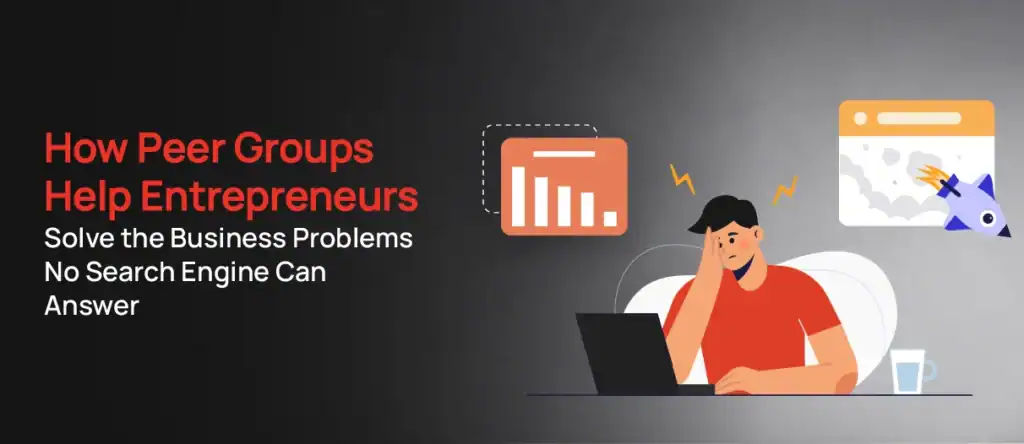
Every founder eventually hits a problem where more research is not the answer, as the problem is too specific, too layered, or too dependent on judgement and context to yield a generic solution. These are the moments when problem-solving in business demands something different: not more data, but the right perspective from someone who has genuinely been there. This blog explores what makes certain business challenges uniquely difficult to navigate alone and why peer groups have become one of the most effective environments for working through them.
What Makes a Business Problem Impossible to Search Your Way Out Of?
Not every business challenge has a clean, searchable answer. The ones that do process questions, technical how-tos, and regulatory information are well served by the internet. But a significant category of business problem and solution thinking falls outside what any search engine can meaningfully address.
These are problems that are highly specific to a founder’s stage, sector, or situation. A co-founder conflict that has been simmering for two years. A pricing strategy shift that could reposition the business entirely or alienate its most loyal customers. The decision to let go of a long-term team member who helped build the company but is no longer the right fit for where it is headed.
These challenges involve people, trust, and judgement rather than process. There is rarely a right answer waiting to be discovered. There is only a better or worse decision, shaped by context that no framework fully captures.
This is where generic problem-solving ideas for business fall short. The gap is not between knowing and not knowing. It is between information and genuine insight, and that gap can only be bridged by someone who has faced something genuinely similar and can bring their lived experience to the conversation.
Why Are Peer Groups Built for These Kinds of Problems?
1. Lived Experience Over Theoretical Frameworks
How peer groups help entrepreneurs is not through structured curricula or expert-led sessions alone. It is through the lived experience that every member brings to the table. When a founder shares a difficult challenge in a peer group, the responses they receive are not drawn from frameworks or playbooks. They come from people who have navigated comparable terrain and can speak to what it actually felt like to make that call.
2. Non-Competing Membership as the Condition for Honest Sharing
For a peer group to function well, members need to feel safe bringing their real problems to the table. Non-competing membership creates that condition. When no one in the room is in the same market, the incentive to hold back disappears, and genuinely honest exchange becomes possible.
3. Confidentiality as the Foundation
Confidentiality is not a feature of a good peer group. It is the foundation. Without it, founders share polished versions of their challenges rather than the real ones, and the quality of the exchange drops significantly. Solving business challenges through peer networks depends entirely on the trust that confidentiality makes possible.
4. Why the Format Matters as Much as the People
The structure of a peer group shapes the quality of interaction that emerges from it. Consistent membership, regular cadence, and a facilitated format that moves beyond surface-level sharing toward genuine problem engagement are what separate a peer group from a casual gathering of entrepreneurs.
The Kinds of Problems Peer Groups Solve Best
1. Leadership and Team Decisions
Some of the hardest decisions a founder makes involve people. When to let someone go, how to restructure a team that has outgrown its original shape, and how to manage a co-founder dynamic that has become complicated. These decisions carry personal weight and organisational consequence simultaneously, and they are exactly the kind of business problem and solution conversations that benefit most from a peer perspective.
2. Strategic Pivots
Before committing resources to a new direction, pressure-testing the thinking with founders who have navigated similar pivots is one of the most practical things a founder can do. The advantages of peer group exchange are most visible here: a room of people who have made comparable bets, in different industries, can surface risks and angles that internal thinking rarely generates.
3. Pricing and Positioning
Pricing decisions sit at the intersection of strategy, psychology, and market reality. Getting grounded perspectives from founders who have faced similar decisions and who have no stake in the outcome produces a quality of input that is genuinely difficult to find anywhere else.
4. Scaling Challenges
Operational bottlenecks, people-related roadblocks, and financial constraints that emerge during scaling rarely have textbook answers. They require judgement shaped by experience, and solving business challenges through peer networks gives founders access to exactly that.
5. Personal Founder Challenges
Isolation, decision fatigue, and the weight of responsibility are not operational problems, but they affect operational performance more than most founders acknowledge. A peer group that creates space for these conversations alongside the business ones addresses the whole founder, not just the business they are running.
Find the right peer group and solve your hardest business challenges with ASCENT.
How do Peer Groups Create the Conditions to Learn from Entrepreneurs?
The shift from passive learning to active, experience-led exchange is one of the most significant things a peer group enables. To learn from entrepreneurs who are one or two steps ahead is more immediately applicable than learning from those who scaled decades ago in a completely different market environment.
- Active exchange over passive learning: Being in the room with a founder who is working through a decision is fundamentally different from reading about how they eventually resolved it. The nuance, the uncertainty, and the real-time thinking are what make peer exchange genuinely useful.
- Stage relevance matters: Perspective from someone who navigated a similar challenge recently lands differently from perspective drawn from a distant past. The context is more familiar, the language is more current, and the insight is more directly applicable.
- Cross-industry thinking unlocks new angles: A business problem and solution worked out in one sector often has direct relevance to a founder in a completely different space. These connections only emerge when diverse founders engage consistently in the same room.
- Consistent engagement compounds over time: Every session builds on the ones before it. Trust deepens, pattern recognition sharpens, and quality of business problem-solving improves in ways that are difficult to attribute to any single conversation but impossible to ignore over time. Engaging with an entrepreneur peer group or attending an entrepreneur meet regularly is what makes this compounding possible.
How Does the ASCENT Foundation Create the Right Environment for This?
Most founders who find their way to ASCENT Foundation are not looking for another programme or platform. They are looking for a room where they can finally say what they are actually dealing with.
We have built a trusted peer-learning ecosystem where the conditions that make honest exchange possible, trust, confidentiality, stage relevance, and non-competing membership are factored into the design rather than left to chance. For founders who have been carrying their hardest problems alone, exploring ASCENT membership or engaging with a community built around genuine peer exchange is about finding a room where those problems finally get the thinking they deserve.
Join a trusted peer community built for growth-stage founders like you today.
Conclusion
The problems that define a founder’s journey are rarely the ones with clean answers. They are the ones that require judgement, context, and the perspective of someone who has genuinely been there. Peer groups do not solve these problems for founders. They create the conditions in which founders solve them better. The right peer environment, built on trust, confidentiality, and consistent engagement, is one of the most valuable things a growth-stage founder can build. The longer you stay in the right room, the sharper your thinking becomes.
Faqs

ASCENT Foundation
ASCENT Foundation is a non-profit community for growth-stage entrepreneurs, focused on mentoring and peer learning. Founded in 2012 by Harsh Mariwala, ASCENT brings entrepreneurs together to share knowledge, build meaningful connections, and support each other’s growth.