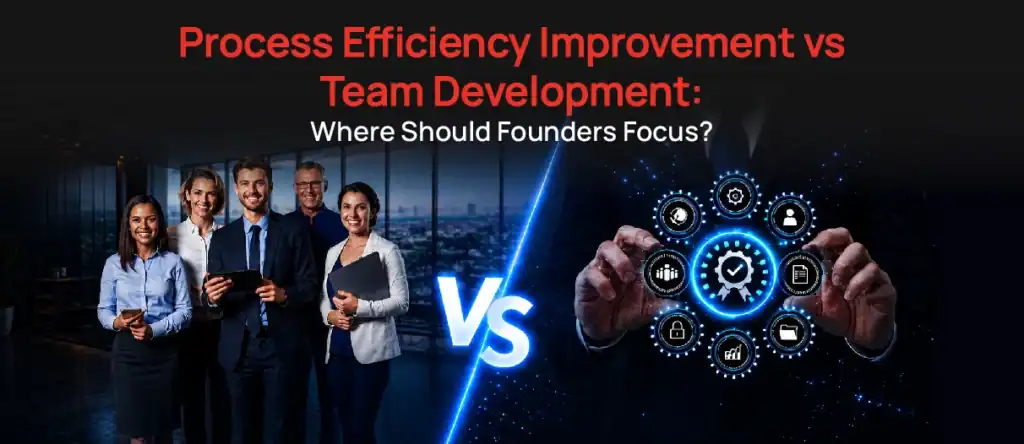
Most founders, at some point, face a version of the same question: is the business slowing down because the processes are broken or because the team is not performing? The instinct is often to fix one or the other. Build a better system. Hire better people. But sustainable business growth rarely comes from choosing between the two. It comes from understanding how efficient business processes and strong teams work together, and this blog helps founders think more clearly about where their attention is most needed.
What Is Process Efficiency and Why Does It Matter?
At its most straightforward, it is the ability to achieve consistent, high-quality output with the least wasted time, effort, or resources. Business process efficiency is not about doing things faster for the sake of speed. It is about building systems that allow the right things to happen reliably, without requiring constant founder involvement or repeated problem-solving.
Efficient business processes create consistency across the organisation. They reduce operational friction, improve repeatability, and give teams a reliable framework within which to work. When a process is well designed, it removes ambiguity and allows people to focus their energy on high-judgement decisions rather than repeating routine steps.
The important distinction is that processes should enable people, not replace their judgement. A process that dictates every step leaves no room for the adaptability that growth demands. The goal is structure that supports decision-making, not structure that substitutes for it.
Why Team Efficiency Goes Beyond Productivity?
Improving team efficiency is not the same as making people work faster or harder. A team that is moving quickly in the wrong direction is not efficient. True team efficiency is about clarity, ownership, collaboration, and the trust that allows people to act decisively without waiting for permission.
- Clarity and ownership drive performance: An efficient team understands what it is trying to achieve, why it matters, and what decisions it is empowered to make. It does not just execute instructions; it takes responsibility for outcomes.
- Collaboration builds better decisions: Teams that communicate openly and challenge each other constructively make sounder decisions than those where information stays siloed and deference overrides good judgement.
- Trust enables adaptability: The difference between a productive team and an efficient one is most visible when things go wrong. A productive team completes tasks. An efficient team adapts, solves, and keeps moving. This quality comes from the trust that allows people to act without waiting for permission at every step.
Process Efficiency vs Team Efficiency: What Drives Sustainable Business Growth?
1. Processes Build Consistency
Standardising routine work removes the friction that comes from reinventing the same solution repeatedly. Process efficiency improvement reduces operational inconsistency, improves the quality of repeatable tasks, and frees up mental bandwidth for the work that actually requires thinking. Without this foundation, even strong teams spend too much of their energy on work that a well-designed system could handle.
2. Teams Bring Adaptability
No process can anticipate every situation. Teams fill the gap that systems cannot. An engaged, capable team responds to unexpected challenges, makes sound decisions without waiting for instructions, and brings the kind of continuous improvement mindset that keeps the business relevant as conditions change.
3. Processes Improve Speed, Teams Improve judgement
Efficient business processes streamline execution. They make the predictable parts of the business faster and more reliable. But judgement—knowing when to follow the process and when to break it—cannot be systematised. That is a team capability. Founders who build strong processes without developing team judgement create organisations that are fast but brittle.
4. Strong Teams Make Strong Processes Better
The best processes are rarely designed by founders alone. They are refined over time by the people closest to the work. Good teams identify gaps in workflows, flag inefficiencies, and suggest improvements that no top-down system design would have surfaced. Business process efficiency improves not just through design but through the ongoing contribution of people who care about the quality of their work.
5. Great Processes Cannot Compensate for Weak Leadership
Even the most well-designed system fails if accountability and ownership are missing. Leadership determines how effectively processes are followed, how honestly gaps are reported, and how consistently improvement is pursued. Management efficiency is not just about the quality of the system in place. It is about the quality of the leadership that operates within them.
6. Sustainable Growth Happens When Both Work Together
Processes create structure. Teams create momentum. The businesses that scale sustainably are the ones where systems empower people rather than control them. When efficient business processes and capable, trusted teams operate together, the organisation can grow without the founder needing to be the answer to every question.
Learn from founders who have balanced systems and people to scale sustainably.
Finding the Right Balance Between Systems and People
Process efficiency improvement is not a project with a finish line. It is an ongoing responsibility that evolves as the business grows.
1. Evaluate Whether Systems Enable or Restrict Decision-Making
Founders must always consider whether the processes they have established are providing clarity and confidence to their teams or instead are causing bottlenecks and forcing all decisions back up the line. What is working now may not work in the next phase of growth.
2. Shift From Founder-Led Execution to Empowered Teams
This shift does not happen automatically. It takes intentional investment in both the systems that provide clarity for teams and the development that builds confidence for teams. When people understand the why behind a process and not just the how, they are far better placed to improve it over time.
3. Evolve People and Processes Together
Management efficiency improves when systems and people develop in parallel rather than in isolation. Upgrading a process without developing the team’s capability to use it well produces limited results. Developing the team without giving them a reliable system to work within creates capable people operating in avoidable chaos.
4. Leadership Development as the Bridge
Leadership development is what connects operational efficiency to organisational growth. A founder who develops their team’s judgement, not just their task completion, creates an organisation that can adapt, improve, and scale without becoming dependent on any single person. The balance between systems and people shifts depending on where the business is and what it needs most at any given stage.
Why Collective Learning Helps Founders Build More Efficient Businesses?
Many founders struggle to identify whether their growth challenges stem from processes, teams, or leadership. From the inside, it is genuinely difficult to see which lever needs to be pulled. A business that feels chaotic might have a process problem, a team development problem, or a leadership clarity problem, and the symptoms often look similar regardless of the cause.
These blind spots are consistently easier to recognise through candid conversations with founders who have faced the same uncertainty. Someone who has already navigated the shift from founder-led execution to empowered teams brings a perspective on improving team efficiency and business process efficiency that no consultant or framework can fully replicate.
Connecting through entrepreneur events in India or engaging with a peer growth community for business owners creates the conditions for this kind of honest, experience-led exchange. ASCENT Foundation is a trusted peer-learning ecosystem where growth-stage entrepreneurs engage in candid discussions and gain fresh perspectives on building businesses that grow sustainably. Exploring ASCENT membership is a meaningful step toward finding that environment.
Join a trusted peer community built for growth-stage founders navigating the same challenges.
Conclusion
Process efficiency and team development are not competing priorities. They are complementary ones. Founders who invest only in systems build organisations that are consistent but rigid. Founders who invest only in people build organisations that are capable but inconsistent. The businesses that scale well do both, deliberately and in sequence, understanding that strong processes and strong teams reinforce each other at every stage of growth.
Faqs
ASCENT Foundation
ASCENT Foundation is a non-profit community for growth-stage entrepreneurs, focused on mentoring and peer learning. Founded in 2012 by Harsh Mariwala, ASCENT brings entrepreneurs together to share knowledge, build meaningful connections, and support each other’s growth.