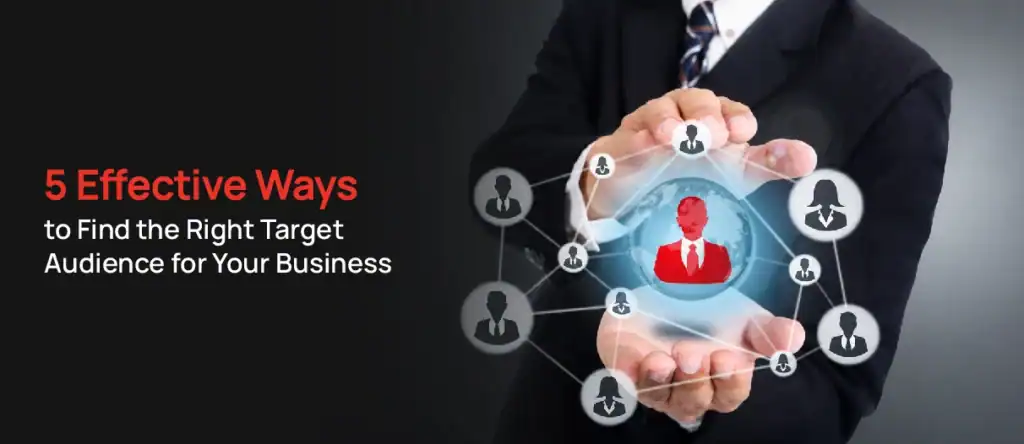
One of the most common reasons a business struggles to grow is not the product, the pricing, or the team. It is the audience. When a business tries to speak to everyone, it ends up resonating with no one. Understanding how to find your target audience is one of the most important foundations a founder can build, and it is also one of the most consistently overlooked. This blog outlines what target audience identification actually involves, the mistakes that get in the way, and five practical steps that help businesses reach the right people with the right message.
What Is a Target Audience in Business?
A target audience is the specific group of people most likely to need, want, and buy what a business offers. It’s characterised by several factors such as demographics, behaviours, challenges, motivations, and buying patterns.
Every business needs a clearly defined audience because without one, every decision, from marketing to product development to pricing, is made without a reliable reference point. Target audience identification is not about excluding people. It is about understanding who the business serves best and directing its energy, messaging, and resources toward those people with intention and clarity.
The difference between trying to reach everyone and reaching the right audience is the difference between being broadly visible and being genuinely relevant. Relevance is what drives action.
Common Mistakes Businesses Make While Targeting Customers
Most targeting failures are not the result of bad intentions. They are rooted in assumptions and habits that seem sensible but quietly work against the business’s ability to connect with the right customers.
- Trying to appeal to everyone: When a business positions itself for everyone, it stands for nothing in particular. The broader the claim, the weaker the resonance with any specific group.
- Relying on assumptions instead of research: Many founders build their audience profile based on who they think their customers are rather than who they actually are. Assumptions age poorly. Research does not.
- Copying competitors without understanding their own audience: What works for a competitor may be built on a different customer base, a different positioning, or a different stage of growth. Copying the approach without understanding the context produces inconsistent results.
- Ignoring customer feedback: Existing customers are one of the richest sources of audience insight available. Founders who do not listen to them miss the information that would help them attract more of the right people.
A structured approach to researching your target audience addresses all of these and replaces assumptions with clarity.
5 Practical Ways to Find and Reach the Right Target Audience
1. Define Your Ideal Customer Persona
A customer persona is a detailed profile of the person most likely to buy from your business. It goes beyond basic demographics to include goals, frustrations, decision-making triggers, and the language they use to describe their own challenges.
Building a persona forces clarity. It transforms broad intentions such as “we serve small business owners” into concrete knowledge: who they are, what they want to accomplish, what stands in the way of their success, and how your business can play a part in that equation. This is the starting point for everything that follows.
2. Research Customer Needs and Pain Points
Customer research techniques don’t have to be complicated to be effective. Whether it’s a conversation with existing customers or analysing competitor products, social media listening or direct feedback, the language, concerns, and priorities of the people you’re trying to reach are all exposed.
The goal is to understand not just what customers buy but why they buy it, what problem it solves, and what would make them choose one business over another. This level of understanding is what separates messaging that lands from messaging that gets ignored.
3. Identify What Makes Your Business Different
The first step in knowing how to reach your target audience is to understand why your business is the best choice for that audience. What do you do differently? What do you do better? Who benefits most from that difference?
When a business is clear about its differentiation, it becomes much easier to identify the audience for whom that differentiation matters most. The two questions, ‘Who are we for?’ and ‘What makes us right for them?’, are answered together, not separately.
4. Study Where Your Audience Spends Time
Reaching the right audience requires being present where they already are. Audiences consume content in different ways, on different platforms, at different events and from different sources of information.
The knowledge of where your target market can be found online and offline will influence where your marketing dollars go and how you present yourself. A business that shows up in the right places with the right message reaches its audience far more effectively than one that broadcasts broadly and hopes for the best.
5. Test, Measure and Refine Your Strategy
No audience profile is perfect on the first attempt. Refining your target audience requires testing assumptions, tracking real-world performance, and adapting based on data.
Through small, low-cost experiments—whether a targeted ad, a fresh piece of content, or a new channel—you generate real data that either validates or challenges your assumptions.
Sharpen your audience strategy with peers who have navigated the same challenges.
Why Target Audience Identification Is an Ongoing Process
As customer expectations evolve, markets shift, new competitors emerge, and businesses grow into segments that did not exist before, a target audience that was accurate two years ago may no longer reflect who the business actually serves or who it wants to serve next.
That is why the most effective founders revisit their target audience regularly, treating it as an ongoing discipline rather than something they figured out once and moved on from. Relying on outdated insights is one of the quieter ways a business loses relevance without realising it.
Benefits of Identifying the Right Target Audience
Getting audience clarity right has a compounding effect across almost every part of the business.
- Better marketing decisions: When you know exactly who you are speaking to, every marketing choice, from channel selection to messaging, becomes sharper and more deliberate.
- Stronger customer relationships: Products, services, and experiences designed with a specific persona in mind resonate far more deeply than those built for a generic average customer.
- More relevant messaging: When you know your audience, you can tailor your message to their needs, concerns and desires, instead of trying to appeal to everyone.
- Better product development: Understanding what your customers actually need, rather than what you assume they need, leads to better prioritisation and more useful solutions.
- Smarter use of resources: Focusing effort on the right people and the right places makes a huge difference compared to trying to be everything to everyone, everywhere.
- Sustainable business growth: The cumulative effect of these targeted strategies is growth driven by genuine relevance rather than brand visibility, which compounds over time.
Why Shared Learning Helps Entrepreneurs Understand Customers Better?
Some of the most useful audience insights a founder encounters do not come from data or research tools. They come from conversations with other entrepreneurs who have navigated similar challenges.
Hearing how another founder discovered their ideal customer, refined their messaging, or pivoted their positioning based on feedback they almost missed brings a level of practical insight that no framework fully captures. These conversations surface blind spots that are easy to overlook when you are too close to your own business.
ASCENT Foundation is a trusted peer-learning ecosystem and collaborative learning community where growth-stage entrepreneurs share real experience, challenge each other’s assumptions, and develop the kind of audience understanding that comes from collective wisdom rather than isolated thinking.
Join a trusted peer community built for founders serious about sustainable growth.
Conclusion
Finding the right target audience is not a one-time task. It is an ongoing process of research, testing, and refinement that shapes every part of how a business grows. The founders who get this right are not necessarily the ones with the most data. They are the ones who stay genuinely curious about their customers, keep questioning their assumptions, and surround themselves with perspectives that help them see what they might otherwise miss. To learn more or take the next step, explore ASCENT membership or reach out to our team.
Faqs

ASCENT Foundation
ASCENT Foundation is a non-profit community for growth-stage entrepreneurs, focused on mentoring and peer learning. Founded in 2012 by Harsh Mariwala, ASCENT brings entrepreneurs together to share knowledge, build meaningful connections, and support each other’s growth.