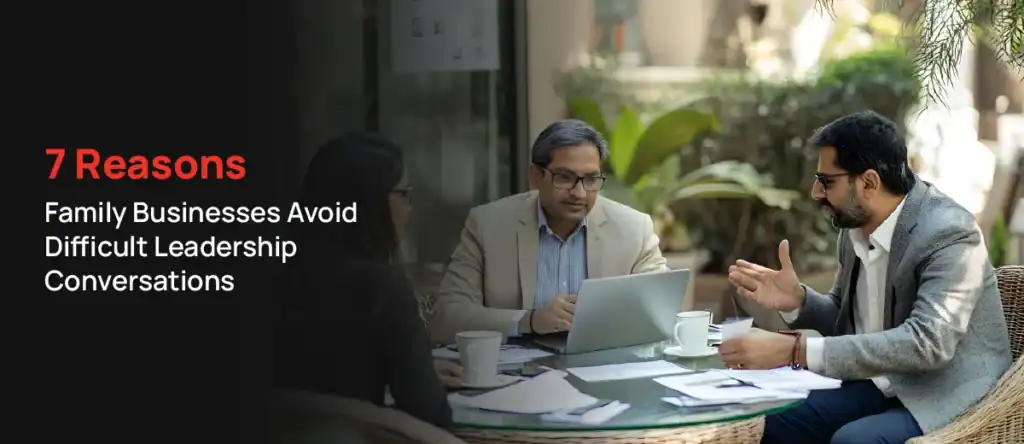
In most family businesses, everyone knows which conversation needs to happen. Who takes over when the founder steps back. Whether a family member is the right person for a senior role. How decisions will be made when the next generation takes charge. Yet these conversations keep getting pushed back, sometimes for years. Family business communication about leadership is one of the most consistently avoided topics in business, not because families don’t care, but because the stakes feel too high and the starting point is unclear. According to a Kreischer Miller survey of US family-owned businesses, 45.9% have no formal succession plan in place. This blog explores why that avoidance happens, what it costs, and how to begin.
Why Are Leadership Conversations So Hard in Family Businesses?
In most businesses, a difficult leadership conversation is a professional matter. In a family business, it is also a personal one. The same people sitting across the table are parents and children, siblings, or lifelong partners. That overlap makes every leadership topic feel loaded in a way that purely professional relationships do not experience.
The result is a specific set of communication problems in business that show up consistently across family-owned companies: assumptions replacing direct conversations, decisions made informally over dinner rather than in structured forums, and roles that are understood by the family but never clearly defined for the organisation.
These patterns are manageable when the business is small and daily operations are aligned. They become harder to sustain as the business grows, more family members join, and the decisions at stake become more consequential. What started as an informal way of working gradually becomes a structural gap that leadership transitions expose.
7 Reasons Family Businesses Avoid Difficult Leadership Discussions and Why They Matter
1. Fear of Disturbing Family Harmony
The most common reason difficult conversations in family business get avoided is the fear of what they might do to the relationship. Families worry that raising succession, performance, or authority will create conflict that outlasts the meeting and damages something far more important than the business decision at hand.
The result is that the issues get postponed rather than resolved. Small disagreements are smoothed over rather than addressed. And over time, the unspoken accumulates into something much harder to untangle than the original conversation would have been.
2. Founders Find It Hard to Let Go of Control
For many founders, the business is not just a professional achievement. It is tied to their identity, their sense of purpose, and decades of their life. Conversations about handover feel less like planning and more like confrontation with something they are not ready to face.
There is also a genuine concern that successors will not maintain the standards, relationships, or culture the founder has built. So the handover conversation gets delayed, sometimes indefinitely, until circumstances force it rather than planning enabling it.
3. Family Roles and Business Roles Are Blurred
In many family businesses, it is genuinely unclear who decides what. The family hierarchy and the business hierarchy do not always align, and when they conflict, the family hierarchy tends to win. A younger family member with the right skills may defer to an older one with seniority but less relevant experience.
This blurring creates communication problems in a business context beyond the family, because nonfamily professionals are unclear about responsibility, which affects their confidence and persistence.
4. “We’ll Deal With It Later” Becomes the Default
Day-to-day operations create constant urgency. Leadership planning, by contrast, feels abstract and non-urgent as long as the founder is healthy and the business is functioning. It is easy to keep deferring a conversation that has no immediate deadline.
The risk is that an unexpected event, an illness, a sudden departure, or a dispute that escalates forces an unplanned transition at the worst possible moment. Managing leadership in a family business well means having the conversation before circumstances demand it. Not after.
5. Doubts About Whether the Next Generation Is Ready
Uncertainty about the next generation’s skills, interest, or outside experience makes the succession conversation feel premature. Owners avoid raising it rather than risk committing to a decision they are not confident about.
The absence of a formal development path for future leaders compounds this. Without a clear process for building readiness, the question of whether the next generation is prepared never has a satisfying answer, so the conversation keeps getting deferred.
6. Complex Ownership and Shareholder Arrangements
Not all family members are equally involved in the business. Some hold stakes as passive investors, while others work in it daily. Existing agreements may restrict who can hold certain roles or require broad consensus before significant changes are made.
When ownership structures have not been reviewed in years, they become quiet roadblocks to family business leadership transitions. A conversation about who leads next quickly becomes a conversation about legal arrangements that nobody wants to open.
7. No Clear Process or Starting Point
Larger companies have HR teams, legal advisors, and governance frameworks to guide leadership transitions. Most family businesses do not. Owners are unsure how to begin: whether to look inside or outside the family, how to assess candidates fairly, what the financial implications are, and who should be involved in the decision.
That uncertainty produces inaction. Without a clear process, the path of least resistance is to do nothing, which is exactly what most family businesses end up doing until they have no choice.
Join a peer community where founders navigate family business challenges together
What Happens When Leadership Conversations Keep Getting Postponed
Avoidance has a cost, and it accumulates quietly over time. Decisions slow down because authority is unclear. Different visions between generations sit unaddressed until they become sources of real conflict. Sibling and cousin rivalry over roles intensifies when there is no agreed framework for how those decisions are made. Talented non-family professionals, seeing the ambiguity and sensing the politics, quietly leave for environments where the leadership structure is clearer.
When an unplanned transition eventually happens, the business faces it without preparation, without agreed processes, and often without the relationships needed to navigate it well. They make sustained growth harder at every stage, because the organisation cannot move faster than the clarity at the top allows.
How Family Businesses Can Handle Difficult Leadership Conversations?
The starting point is separating family forums from business forums. Conversations about roles, authority, and succession belong in a structured business context, not over a family dinner where the emotional stakes make honest exchange harder.
Establishing a regular rhythm for these conversations, with an agenda and clear purpose, lifts the weight off of any single conversation by normalising the topic and avoiding the sense of it being a crisis each time it is raised.
Putting roles and decision rights in writing gives everyone a shared reference point and reduces the ambiguity that fuels conflict. Starting with smaller, less charged topics before the hardest ones builds the muscle for honest exchange without risking everything on the first conversation.
When the family is too close to the issue, a neutral voice from outside, whether a trusted advisor, a peer who has navigated similar territory, or a structured peer learning environment, can help shift the dynamic. Managing leadership in a family business is not a one-time meeting. It is an ongoing practice that gets easier with repetition and the right support around it.
How Peer Learning at ASCENT Foundation Makes Honest Leadership Conversations Easier?
One of the reasons avoidance continues is that family business owners have very few people outside the family they can talk these things through with. Hearing from founders who have navigated the same difficult conversations in family business, opened the succession discussion, or addressed a family member’s underperformance makes the topic feel less personal and less risky.
ASCENT Foundation’s Trust Groups bring together growth-stage entrepreneurs in a confidential, confidential space where family business founders sit alongside peers who’ve navigated the same succession dilemmas, leadership transitions, and family tensions. The monthly conversations aren’t about business strategy alone; they’re about the personal weight of these decisions and how founders have actually handled them. Hearing from someone who’s already had the difficult succession conversation, or who’s managed a family member’s underperformance, making it feel less like a family crisis and more like a familiar challenge with a path forward.
Connect with founders who have started the conversations your business needs today.
Conclusion
The leadership conversations that family businesses avoid are rarely as destructive as the avoidance itself. Every year a succession plan stays unwritten, every role that stays undefined, and every performance issue that goes unaddressed quietly limits what the business can become. The founders who navigate this well are not the ones who find it easy. They are the ones who build the right environment around them, find the right peers to think alongside, and start the conversation before circumstances force it.
Faqs

ASCENT Foundation
ASCENT Foundation is a non-profit community for growth-stage entrepreneurs, focused on mentoring and peer learning. Founded in 2012 by Harsh Mariwala, ASCENT brings entrepreneurs together to share knowledge, build meaningful connections, and support each other’s growth.